Peak Performance Daily
Recovery · 7 Min Read | By Jake Coleman, Fitness & Recovery Contributor — Aug 25, 2026
Why Active Adults Over 40 Are Quietly Losing Their Workout Consistency — And Most Don't Realize Why Until They've Already Quit
A growing body of peer-reviewed research on essential amino acids — the building blocks your body can’t manufacture on its own — is changing how trainers think about soreness, fatigue, and staying consistent after 40.

It’s 6 AM and the alarm just went off for your workout. But when you swing your legs out of bed, your knees feel like rusted hinges and your lower back tightens before you’ve even stood up all the way. Yesterday’s leg day is still very much present today — and this morning, tomorrow’s session suddenly feels optional.
If that’s familiar, you’re not alone. It’s one of the most common — and most quietly demoralizing — patterns among people who train regularly past 40: the soreness doesn’t fade the way it used to, and it starts dictating the schedule instead of the other way around.
It’s not sharp pain. It’s heavier than that — a thick, waterlogged feeling in the muscle, like it was swapped out overnight for wet sand. You can still move. You just don’t want to. And by the third day of that feeling, plenty of people quietly skip the fourth workout. Then the fifth.
You’ve tried the usual fixes. The foam roller. The extra rest day. The protein shake right after training. Maybe even a massage gun. None of it is useless, exactly — but none of it makes Wednesday morning feel any different. That’s frustrating in a specific way: you’re doing the “right” things, and your body still isn’t cooperating.
Here’s the part almost nobody checks: what your muscles actually have on hand to rebuild with.
The Essential Amino Acid Gap
Nutrition researchers have a term for the shortfall behind a lot of this: some call it the essential amino acid gap — the difference between what your body needs to fully resynthesize muscle protein after training, and what a typical diet, even a protein-heavy one, actually delivers on a given day.
Essential amino acids (EAAs) are the building blocks of muscle protein, and your body cannot manufacture them — they have to come from food or supplementation. Whole food protein delivers all nine, but not always in the ratio or amount your body needs the day after a hard session. That gap is where a lot of “why am I still sore” frustration quietly lives.
What the Research Actually Says
Here’s what peer-reviewed research — indexed on the U.S. National Institutes of Health’s PubMed/PMC database — actually shows about amino acid supplementation and exercise recovery:
- A systematic review of oral BCAA supplementation in athletes found consistent evidence that BCAAs are associated with reduced markers of exercise-induced muscle damage. [1]
- A meta-analysis on muscle soreness found BCAA supplementation was associated with a measurable reduction in delayed-onset muscle soreness (DOMS) after exercise. [2]
- Research on dosage and timing suggests BCAA intake around training sessions may support post-exercise recovery and muscle function at adequate doses. [3]
- A study on muscular and central fatigue during incremental exercise found oral BCAA intake was linked to reduced perceived fatigue during sustained effort. [4]
- A separate systematic review and meta-analysis concluded BCAA supplementation showed a measurable effect in decreasing DOMS after a single bout of exercise. [5]
- Broader research on essential amino acids and skeletal muscle shows EAAs play a well-documented role in stimulating muscle protein synthesis, the process muscle relies on to repair after training. [6]
None of this means amino acids are a cure for anything — soreness and fatigue after exercise are a normal training response, not a medical condition — but it helps explain why sports dietitians increasingly look at EAA sufficiency, not just total protein, when someone’s recovery stalls.
Take someone like Marcus, 42 — trains three times a week, always has. Two years ago he noticed Wednesday’s workout had started feeling like punishment for Monday’s. He tried everything above. What actually changed things, he says, was realizing he’d been eating “enough protein” without ever checking whether he was getting enough of the specific essential aminos his body needed to rebuild on his timeline, not his diet’s.
This is an illustrative scenario reflecting a pattern many people who train regularly report — not a verified individual customer result.
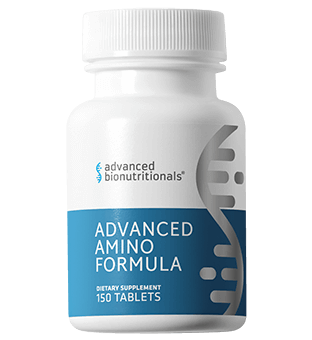
What's Actually Inside — All 8 Essential Amino Acids
Per the official Supplement Facts label: Serving Size 5 tablets, 30 servings per container (150 tablets total), 25 calories per serving. Advanced Amino Formula Blend: 5,000 mg per serving † (†Daily Value not established), listed in this order:
| Amino Acid | Role |
|---|---|
| L-Leucine | The BCAA most studied for triggering muscle protein synthesis |
| L-Valine | Rounds out the BCAA trio studied for muscle recovery |
| L-Isoleucine | Supports energy metabolism during exercise alongside leucine and valine |
| L-Lysine HCl | Essential amino acid the body can’t produce on its own |
| L-Phenylalanine | Essential amino acid involved in protein structure |
| L-Threonine | Supports normal protein structure and function |
| L-Methionine | Sulfur-containing essential amino acid involved in protein synthesis |
| L-Tryptophan | Essential amino acid; precursor role in protein metabolism |
Other ingredients: vegetable stearic acid, silica, cellulose coating. Format: tablets, 150 per bottle (30-day supply at 5/day). Free from gluten, wheat, corn, nuts, seeds, eggs, soy, dairy. Non-GMO, no preservatives, vegan.
Like most amino acid tablets, this is a disclosed proprietary blend: the label gives the combined blend weight and lists ingredients in descending order by weight, not an individual mg amount per amino acid — standard, compliant labeling.
That’s the gap Advanced Amino Formula is built around — a tablet blend of 8 essential amino acids, including the full BCAA trio, dosed in a fixed ratio rather than left to chance the way a mixed-protein diet is. No shake to mix, no powder — just tablets on your own schedule.
Advanced Amino Formula
- 5,000 mg blend of all 8 essential amino acids per serving, led by the 3 BCAAs (leucine, isoleucine, valine)
- 150 tablets per bottle — a 30-day supply at the labeled 5-tablets-a-day serving size
- Simple tablet format — no mixing required
- Non-GMO, gluten-free, dairy-free, soy-free, vegan
- Backed by the manufacturer's satisfaction guarantee (confirm exact terms before publishing)
- Multiple package options available on the official order page
Frequently Asked Questions
Advanced Amino Formula is formulated as a dietary supplement. As with any supplement, consult your physician before use, especially if you are pregnant, nursing, have a medical condition, or take medication.
People who train regularly — strength training, running, or general fitness — who want a simple way to close a possible gap in essential amino acid intake.
It’s a fixed-ratio tablet blend of essential amino acids rather than a full protein source — no mixing, no shake, and a specific, repeatable ratio rather than whatever a given meal happens to contain.
No. This product is not intended to diagnose, treat, cure, or prevent any disease. Muscle soreness and fatigue after exercise are a normal training response, not a medical condition.
ADVERTORIAL — This page contains sponsored content and affiliate/advertising links.
This website and the products described are not intended to diagnose, treat, cure, or prevent any disease. These statements have not been evaluated by the Food and Drug Administration. This product is not a substitute for medication prescribed by your doctor. Individual results vary; testimonials reflect illustrative examples and are not a guarantee of results. Consult your physician before beginning any new supplement, especially if you are pregnant, nursing, have a medical condition, or are taking medication.
Leo Marks
450 Gears Rd., Suite 200
Houston, TX 77067
United States
Terms of Service | Privacy Policy | Affiliate Disclosure | Contact
Scientific References
- Oral Branched-Chain Amino Acids Supplementation in Athletes: A Systematic Review. PMC. https://pmc.ncbi.nlm.nih.gov/articles/PMC9571679/
- Effect of Branched-Chain Amino Acid Supplementation on Muscle Soreness following Exercise: A Meta-Analysis. PubMed. https://pubmed.ncbi.nlm.nih.gov/30938579/
- Intake of branched chain amino acids favors post-exercise muscle recovery and may improve muscle function: optimal dosage regimens and consumption conditions. PubMed. https://pubmed.ncbi.nlm.nih.gov/33586928/
- Effects of Oral Branched-Chain Amino Acids (BCAAs) Intake on Muscular and Central Fatigue During an Incremental Exercise. PMC. https://pmc.ncbi.nlm.nih.gov/articles/PMC7126259/
- The use of BCAA to decrease delayed-onset muscle soreness after a single bout of exercise: a systematic review and meta-analysis. PubMed. https://pubmed.ncbi.nlm.nih.gov/34669012/
- Essential amino acid supplementation and its effects on skeletal muscle. PMC. https://pmc.ncbi.nlm.nih.gov/articles/PMC10561576/
All references are peer-reviewed systematic reviews / meta-analyses indexed on PubMed/PMC (National Institutes of Health).